

The Advisor Endgame: Wirehouse vs. Independent Succession Options
The wealth industry is gearing up for one of its largest transitions in history. An estimated 100,000 financial advisors are expected to retire in a number of years, representing trillions in client assets poised to change hands.
The wealth industry is gearing up for one of its largest transitions in history. An estimated 100,000 financial advisors are expected to retire in a number of years, representing trillions in client assets poised to change hands.
For advisors nearing retirement, or even those planning five to 10 years ahead, the central question is not if they will monetize their business, but when and how. It’s easy to procrastinate, but the time to plan is now, with revenue at a peak and prior to others rushing to figure out their succession at the last minute as well.
Advisors in a captive environment or even a traditional 1099 program like Ameriprise or Raymond James have two main options:
- Remain at a wirehouse and participate in an internal succession or retirement program
- Transition to a truly independent firm or RIA and monetize equity externally (often via selling the practice or a minority stake)
“What is increasingly clear is that the independent model is reshaping expectations around ownership, valuation, and legacy,” said The Gershman Group CEO Roger Gershman. “This is where the most creativity in terms of financing, affiliation, and payout structure is happening, and advisors can use that to their advantage.”
The Demographic Catalyst: A Supply Shock in Advisor Succession
The scale of the coming advisor retirement wave cannot be overstated. A large portion of the advisor workforce is concentrated in late-career cohorts, and firms are facing a dual challenge:
- Retaining assets internally as advisors retire
- Ensuring continuity of client relationships through next-generation advisors
This has led wirehouses to formalize and expand internal succession programs with earlier entry dates and higher payouts. Some allow advisors to enter as early as 55 if they have been at the firm for a set number of years. At the same time, the independent RIA market, fueled by private equity and aggregators, has driven valuations to levels that traditional firms struggle to match.
The result: advisors now face a fundamentally different set of tradeoffs than even five years ago.
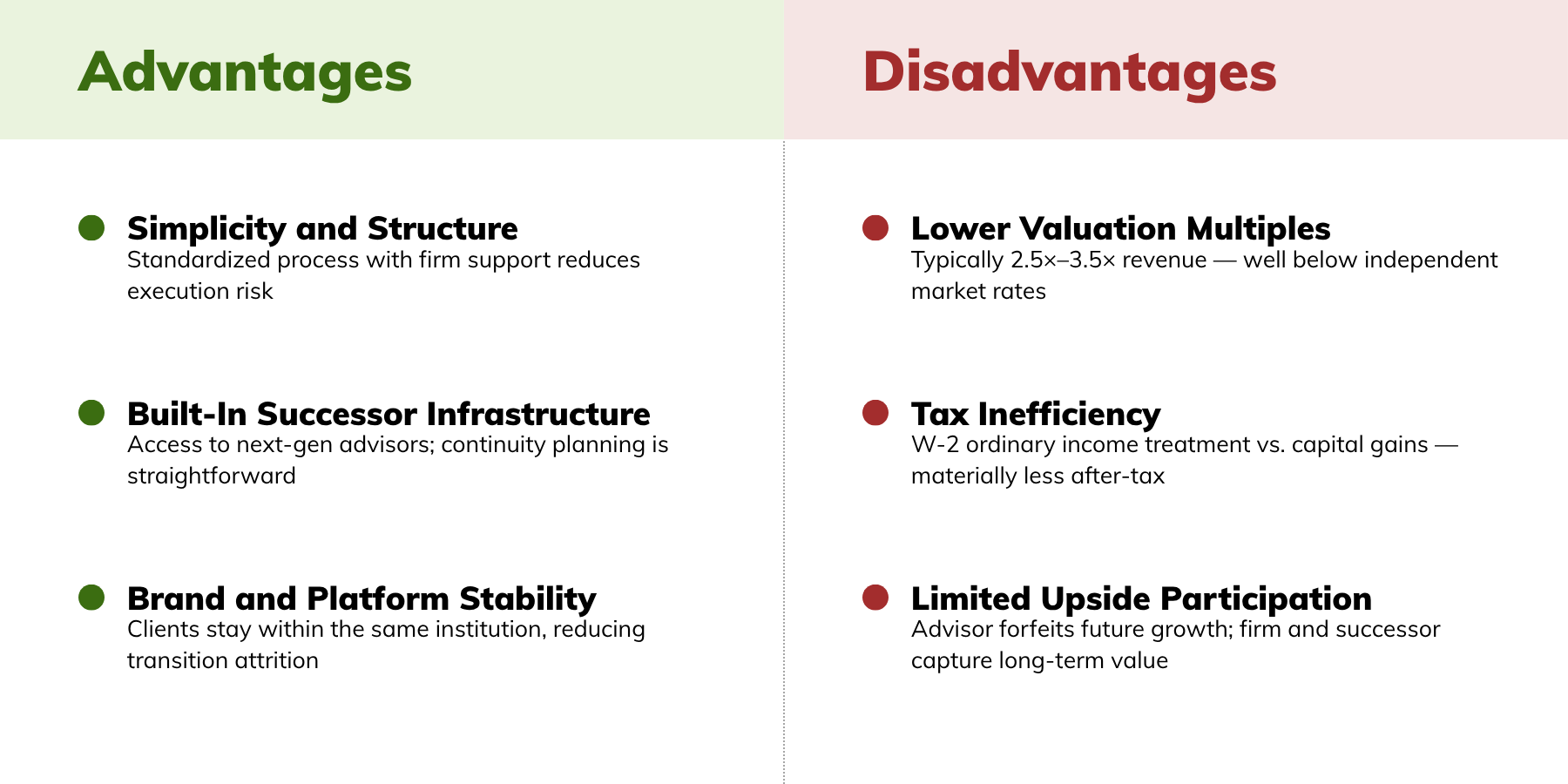
Option 1: Wirehouse Retirement & Succession Programs
How They Work
Wirehouse retirement programs are institutionalized frameworks designed to transition client relationships internally. They work like a somewhat less lucrative recruiting deal. Typically:
- Advisors receive 2.5x–3.5x trailing 12-month production
- Payments are made over 5–7 years
- Compensation is treated as W-2 income
- The advisor must transition clients to a successor within the firm
Key advantages and disadvantages are outlined below.
Option 2: Independence and External Monetization
How It Works
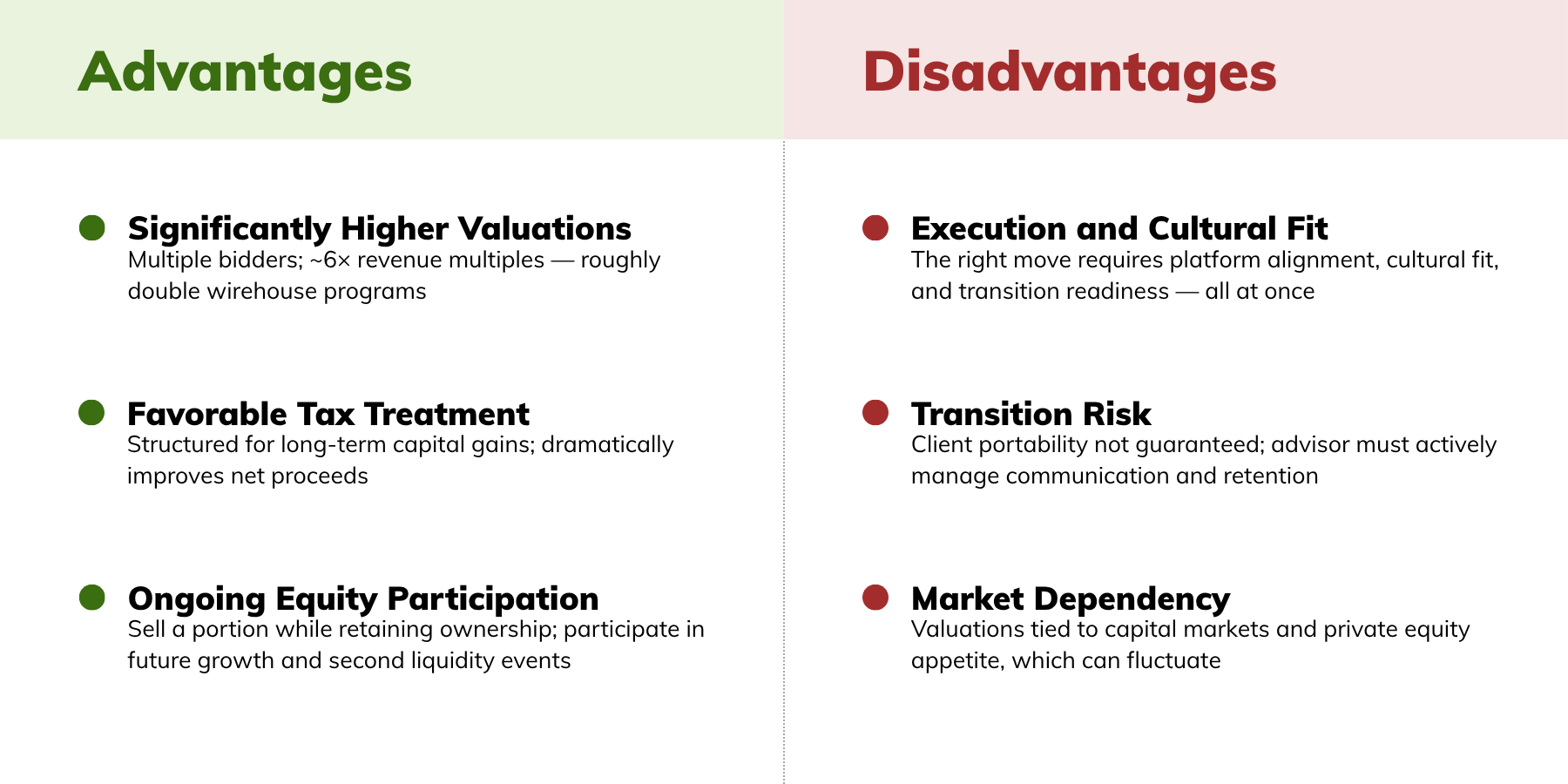
Advisors transition to an independent model (RIA or hybrid) and monetize their business through:
- Minority stake sales (growth capital)
- Majority recapitalizations
- Full sales to aggregators or strategic buyers
Valuations in the independent channel often reach 5x–7x revenue (or more), depending on growth, margins, and scale.
Key advantages and disadvantages are outlined below.
Economic Comparison: A Stark Contrast
The core of the decision is a simple economic question:
Is a lifetime of business-building worth 2.5x–3.5x revenue taxed as ordinary income?
Versus:
~6.0x revenue taxed at capital gains rates, with potential for continued equity upside?
When adjusted for taxes and discounted cash flow:
- Wirehouse programs deliver lower absolute proceeds over time - Independent deals offer higher upfront value + retained upside The disparity becomes even more pronounced when considering that independent advisors:
- Retain more economics during their careers
- Control when and how they monetize
- Can participate in multiple liquidity events
When top teams do the math, they’re choosing independence. It’s why a team with $37 million in revenue left UBS in December last year to launch their own RIA, 71 West Capital Partners. They did not sell a stake as part of their move, but have given themselves the ability to eventually have that flexibility and are no longer confined to the whims of wirehouse comp plan changes.
Strategic Considerations Beyond Valuation
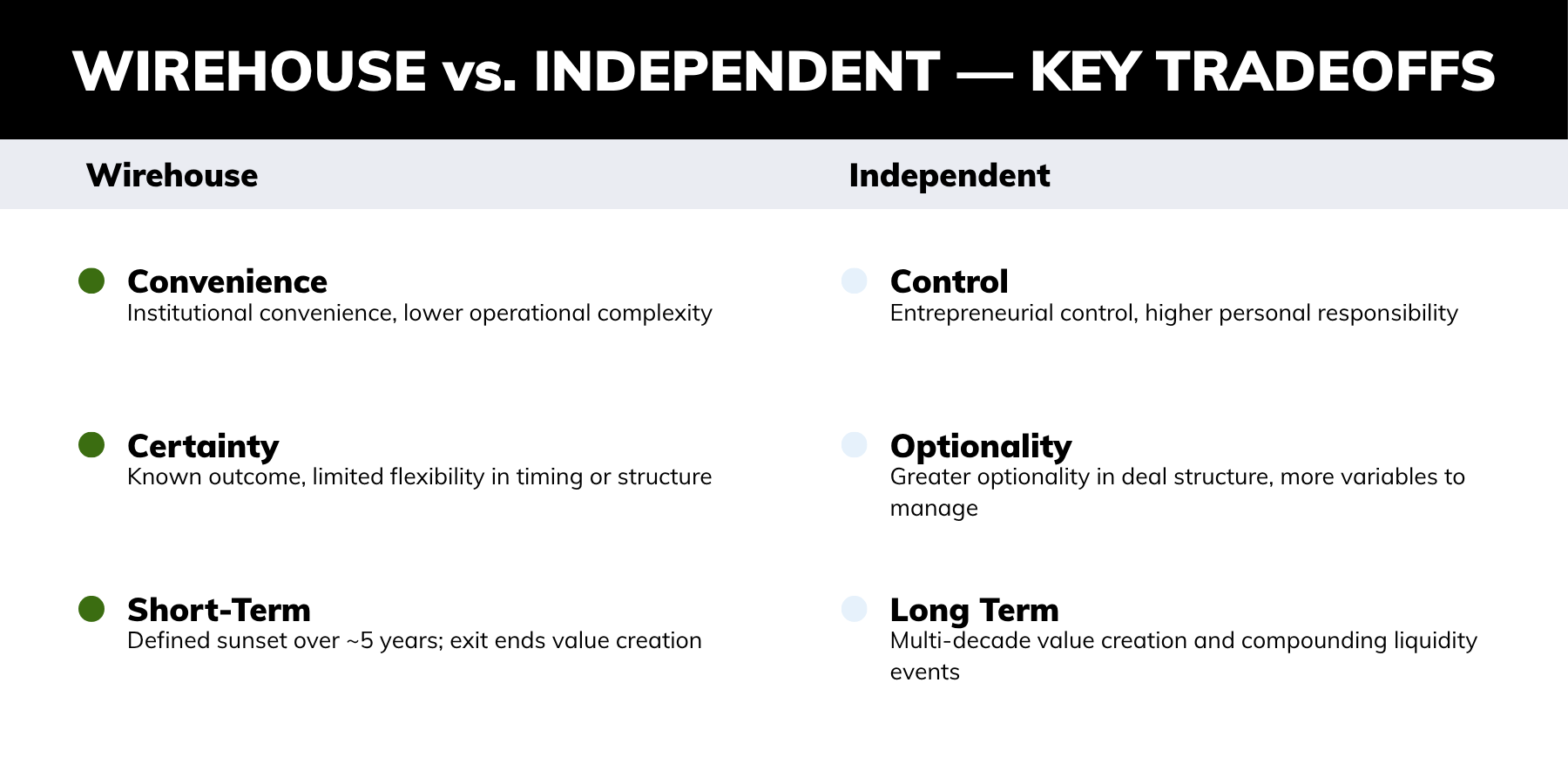
While valuation is critical, the decision is not purely financial.
Key tradeoffs are outlined below.
Conclusion: A Defining Decision for the Next Generation of Retiring Advisors
The coming advisor retirement wave represents a redefinition of how advisory businesses are valued and monetized.
For many advisors, the choice will come down to:
- Certainty and simplicity within a wirehouse framework vs.
- Maximized value and long-term participation through independence
Wirehouses have made smart moves to make their in-house programs more appealing to advisors, but most of the changes have come after independence forced their hand.
YouTube Video: [](https://www.youtube.com/shorts/ZBHPXK3ET9I)